Australian Online Casino Guide: Bonuses, Pokies and Fast Payouts

For players across Australia, the best way to compare online casinos is to look at bonuses, payment options and pokies in one place. If you want 100 free spins no deposit Australia offers, check how wagering requirements work before claiming. Larger packages such as 120 free spins for real money Australia no deposit bonus and 200 no deposit bonus 200 free spins real money can suit different bankrolls, while a 300 free chip no deposit casino is useful for testing a new site. Our guides also cover Apple Pay casino and Australian online pokies so you can move from sign-up to spinning quickly.

Banking matters as much as bonuses. A Bitcoin casino Australia may appeal if you prefer decentralised payments, while Bizzo Casino and other casinos not on BetStop can be worth researching for flexible access. Crypto casinos and e wallet pokies are popular for fast transactions, and you can compare free 10 sign up bonus pokies Australia with free 50 pokies no deposit sign up bonus Australia before choosing a welcome deal. Payment-focused players also ask about Google Pay casino options, and sites like Jackpot Jill Casino often support multiple deposit methods.

Card users are not left out, with Mastercard casino and National Casino pages covering familiar deposits. If you prefer prepaid vouchers, compare Neosurf casinos and always check the latest no deposit bonus codes before registering. For faster withdrawals, an online casino no verification withdrawal Australia guide can help, while PayID casino and PayID pokies Australia no deposit bonus options are increasingly common. Established brands such as Richard Casino and Royal Reels Casino may also feature in our comparisons.

Finally, Skrill casino users can filter for e-wallet friendly sites, and our top 10 online casino Australia real money list highlights trusted operators. A Visa casino remains a straightforward choice for many, while Winspirit Casino and WS Casino show how diverse the Australian market has become. Always read terms, confirm licensing and play responsibly.

Get a FREE insulation grant for your room in the roof worth up to £10,000

Apply today under the government’s Great British Insulation Scheme (GBIS) – eligible households can get their rooms in the attic insulated and freshly plastered with a 100% fully funded grant administered by Ofgem.

Contact us today to see if you qualify

(it takes less than 60 seconds)

You will never be asked to pay for any of the upgrades as part of our GBIS scheme delivery.

What is GBIS?

The Great British Insulation Scheme (GBIS) is a new government energy efficiency scheme that is administered by Ofgem. It is designed to offer improvements to the least energy-efficient homes in Great Britain to help reduce energy bills. Unlike ECO4’s ‘whole house’ approach, this scheme will mostly deliver single insulation measures- we are offering fully funded room in the roof insulation (RIRI).

You do not have to be in receipt of means tested benefits to qualify for GBIS funding. It is available to households with an Energy Performance Certificate rating of D, E. F or G, and within Council Tax bands A, B, C or D in England and A, B, C, D or E in Scotland and Wales. Our support team can check your council tax band and EPC if you are unsure.

How is it free?

The Great British Insulation Scheme (GBIS) places legal obligations on energy suppliers to deliver insulation and heating measures to homes and aims to reduce home heating costs for household. You can be a homeowner, landlord or private renting tenant to apply.

Why should I have room in roof insulation (RIRI)?

Room in roof insulation is used to insulate a loft that’s been converted into a living room (a bedroom or usable room), other than being used just for storage.
If you want to use your loft as a living space, or it is already being used as a living space, then you need to make sure that all the walls and ceilings between a heated room and an unheated space are insulated.
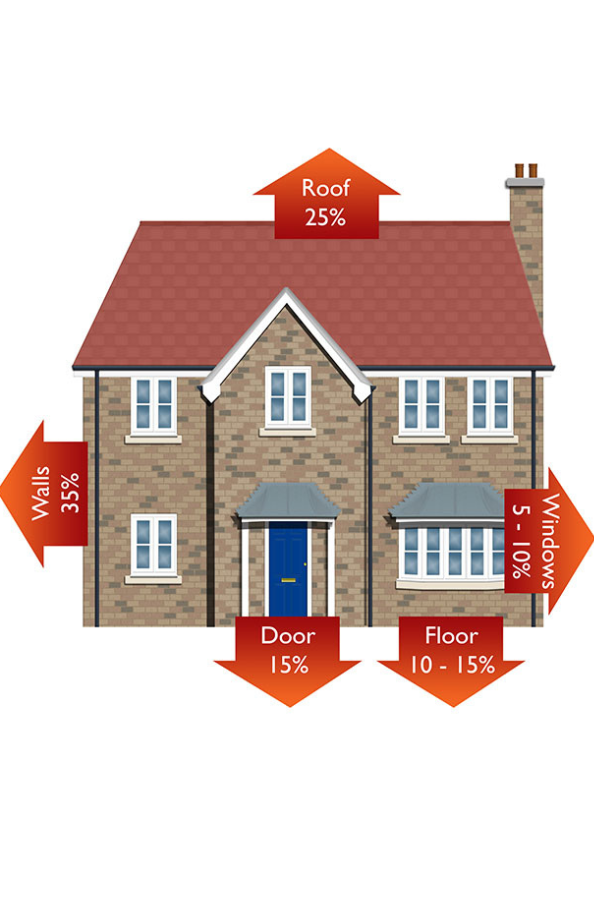
Heat loss through roofs accounts for 25% of heat loss from dwellings.
The main sources of heat loss in relation to roofs are:
It is essential to have good airtightness in building construction as it protects existing construction elements and seals uncontrolled air leakage pathways at junctions and edges. Good airtightness reduces heat loss and helps to avoid unintended consequences such as condensation.

Save..

hundreds of pounds a year

Help..

save the environment

Protect..

against future price rises

Increase..

the value of your home

What are the benefits of room in roof insulation (RIRI)?

Room in the roof insulation (RIRI) helps to increase and maintain the internal temperature as well as providing a higher surface temperature, both of which contribute to improved comfort. Properly installed RIRI will improve thermal comfort and reduce energy bills for households and contribute towards reducing greenhouse gas emissions.
Insulating the RIR from the inside can be done without the use of scaffolding and in any weather and avoids a change in the roof line. The level of airtightness of a building should improve when installing RIRI.

It is common that ventilation systems in existing dwellings are not adequate and rely on a leaky building fabric to provide sufficient ventilation.

 As part of your GBIS installation, mechanical extractor fan will also be fitted to all kitchens, bathrooms, toilets and utility rooms. Trickle vents will be fitted to all windows and internal doors will adjusted to meet ventilation requirement depths.

Have you been declined for funding in the past?

The criteria for funding changes on a regular basis. If you have been unsuccessful in the past, you may be accepted now as the government is keen to help more households receive free funding. We always let our customers know if new funding has been released and if they can benefit from that too. 

Scroll to Top